TechCrunch Video Summaries
AI-generated English translations of new videos. A no-sign-up video summary & translation page


 📺 Licube Makes the Lithium Isotopes Fusion Needs | Startup Battlefield 2026
Startup Pitch on High-Purity Lithium Refining for Fusion Energy and Advanced Industries
▼
A startup founder presents a company that manufactures high-purity lithium, positioning it as a key fuel for n…
A startup founder presents a company that manufactures high-purity lithium, positioning it as a key fuel for nuclear fusion and a supply source for fast-growing advanced industries. The pitch covers the market, the refining technology, early traction, team background, and a live demonstration of the lab equipment, followed by a Q&A session with the judges.
■ Fusion Energy and Lithium Market
- Why AI-driven electricity demand and nuclear fusion create a need for lithium
- Lithium grades (battery, space, nuclear) and their respective market sizes
- Market outlook and expected timing for fusion-related demand
■ Technology and Business Model
- A single refining process that produces space-grade output and, with additional passes, enriched nuclear-grade lithium
- The company sells lithium powder rather than licensing the technology
- Funding raised, patents, pilot production, early customers, and planned facility expansion
■ Team and Live Demonstration
- Founder background and composition of the scientific and engineering team
- On-stage look at the electrolysis system and a sample of the refined powder
■ Judges' Q&A
- Capital required for commercial-scale production, customer profiles, and purchase pipeline
- Regulatory controls on isotope enrichment, competitive landscape, and future hiring
This is useful for investors, deep-tech and energy-sector founders, and anyone tracking the fusion supply chain. Viewers can gain an understanding of how a critical-materials startup frames its market opportunity, execution risks, and go-to-market path, and can note the near-term milestones the company sets as checkpoints for evaluating progress.
 📺 Satlyt Turns Satellites Into Virtual Data Centers | Startup Battlefield 2026
Satellite CEO Pitch: Turning Existing Spacecraft into Virtual AI Data Centers in Orbit
▼
Ramas Oushing Ofulu, founder and CEO of Satellite, presents the company's vision of running AI and software on…
Ramas Oushing Ofulu, founder and CEO of Satellite, presents the company's vision of running AI and software on spacecraft already in orbit. Along with CTO Nelson Singin, he explains the constraints of satellite downlink capacity, the unused compute flying on today's fleets, and how a single software layer can change that. The session covers the product suite, a live demo, business model, traction, and a judge Q&A.
■ The Problem and the Solution
- Unused onboard compute and downlink bottlenecks, with an estimated $100,000+ of wasted value per satellite per year
- A unified software layer for any compatible spacecraft, keeping operators' full command authority over flight control
■ Product Suite
- SatAI: onboard analysis and information extraction
- SatNet: results delivery over intermittent space links and cross-satellite connectivity
- SatCloud: coordination layer compared to Kubernetes for deploying serviceable workloads in orbit
■ Live Demo and Traction
- Running apps on real flight compute hardware, pre-launch configuration, and real-time execution traces
- AI diagnostics on orbit, and a NASA collaboration on 4K video streaming from the Moon to Earth
- Commercial contracts, a NASA SBIR Phase 2 award, a Transporter-18 rideshare, and an $8M seed round
■ Pricing, Market, and Q&A
- $4,200 per satellite per month for operators; a $10,000 fee plus usage for software vendors
- Satellite population moving from roughly 20,000 today toward an estimated 100,000
- Questions on pricing rationale, retrofitting existing satellites, Starlink's share of launches, competition with closed ecosystems, and the push toward interoperability standards
This is useful viewing for space-tech founders, satellite operators, software developers targeting orbit, and investors. You will come away with a clear picture of how orbital compute is being commercialized, how the pricing and go-to-market logic works, and where standards and interconnection fit in. Consider comparing the claimed figures with public launch and satellite-count data when evaluating the opportunity.
 📺 Flox Intelligence Keeps Animals Off Runways and Rails | Startup Battlefield 2026
عرض Flux Intelligence: استخدام الذكاء الاصطناعي لتفسير تواصل الحيوانات ومنع التصادمات في المطارات والطرق
▼
شركة Flux Intelligence تقدم جهاز الذكاء الاصطناعي الطرفي Flux Edge الذي يجمع بين الرؤية الحاسوبية والنداءات ال…
شركة Flux Intelligence تقدم جهاز الذكاء الاصطناعي الطرفي Flux Edge الذي يجمع بين الرؤية الحاسوبية والنداءات الصوتية الحيوية لتفسير تواصل الحيوانات ومنع التصادمات في المطارات والسكك الحديدية والطرق. يشاركنا الفريق تفاصيل التقنية والانتشار الجغرافي ونموذج الأعمال، بالإضافة إلى إجابات على أسئلة لجنة التحكيم حول قابلية التوسع وحجم السوق.
■ التقنية والمنتج
- آلية عمل Flux Edge من اكتشاف الحيوان حتى إصدار النداء الصوتي المناسب على الجهاز مباشرة
- عرض حي على المسرح لتفاعل الجهاز مع حيوان
- شراكة مع Alstom لتطبيق البرمجيات على القطارات في أوروبا
■ النشر وقابلية التوسع
- الانتشار في ثلاث قارات مع مطارات دولية ومديري أراضي ومشغلي طرق
- دورة المبيعات مع مطار دنفر الدولي وعدد الأجهزة اللازمة لكل موقع
- سوق المطارات مقارنة بإجمالي السوق المتاح في القطاعات الأخرى
■ الأعمال والفريق
- هوامش الربح على الأجهزة والبرمجيات وآلية التسعير
- خلفية الفريق في شركات تقنية عالمية ومؤسسات أكاديمية متخصصة
مناسب لمن يعمل في مجالات التقنية العميقة والحفاظ على الحياة البرية والذكاء الاصطناعي التطبيقي والشركات الناشئة. يساعد على فهم كيفية استخدام تقنيات الذكاء الاصطناعي الطرفي في حل مشكلات واقعية، وكيف تبني الشركات نماذج أعمال قابلة للتوسع.
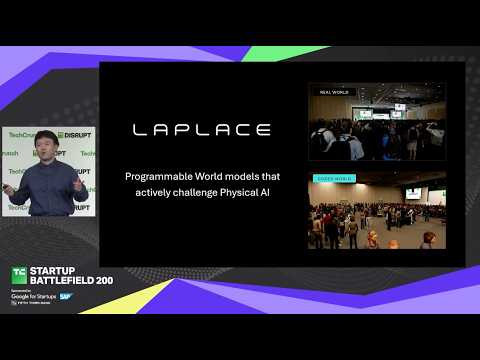 📺 Laplace Intelligence: World Models for Cities & Ports | Startup Battlefield 2026
Latent Intelligence: AI-Generated World Models for Testing Physical AI Before Real-World Deployment
▼
This talk introduces Latent Intelligence, a startup building generative world models and AI test agents that d…
This talk introduces Latent Intelligence, a startup building generative world models and AI test agents that design challenging, realistic environments to stress-test physical AI systems before real-world deployment. It covers the cost and time barriers of traditional simulation building, a live demo of autonomous failure-case generation for delivery robots, and the founders' research background from the University of Michigan.
■ The Problem with Traditional Simulation
- Manually designed test environments: M City 2.0 took about $250K and 15 months of human effort
- Scenario authoring still relies on human intuition; hard to scale for robots across varied places and tasks
■ Product & Demo
- Agent-based closed loop: a test agent proposes challenges while a world model generates and adapts the environment
- Demo of a coffee-delivery robot navigating crowds, corners, and unexpected safety-critical events
- Cost reduction to roughly $600 (about 300 GPU-hours) per environment in the current stage
■ Research, Traction & Market
- Founding team's Michigan research background and Nature cover feature
- Clients and partners: leading automakers, autonomous trucking company Bot Auto, a US DOT challenge, robot makers, and an NVIDIA Metropolis/VSS demo with the City of San Jose
- Competitive positioning against open-source entrants such as NVIDIA's Cosmos
This is useful viewing for developers of autonomous vehicles, delivery and humanoid robots, as well as simulation, safety, insurance, and regulatory professionals. Viewers will come away with a clearer picture of how generative world models can automate test-case discovery, reduce verification costs, and produce shared evidence for deployment approval — and where the field is heading next.
 📺 Veritas: Authenticating Luxury With Microchips | Startup Battlefield 2026
Veritise Pitch: Hardware-Based Chip Technology for Verifying Luxury Product Authenticity
▼
Founder and CEO Lucy Holland presents Veritise, a company developing secure electronic chips and software that…
Founder and CEO Lucy Holland presents Veritise, a company developing secure electronic chips and software that let anyone instantly verify whether a luxury product is genuine. She explains the scale of counterfeiting for luxury brands, why QR codes and NFC tags fall short, and how the EU Digital Product Passport regulation coming into effect in 2027 creates new demand for a hardware-based authentication solution.
■ The Authentication Problem
- Counterfeit losses for luxury brands and the limits of current QR and NFC solutions
- The EU Digital Product Passport (DVP) requirement taking effect in 2027
■ The Veritise Solution
- Custom chip specifications: thin, washable, water-resistant, and integrable into garments
- How the chip links to a digital identity with an authenticity certificate
- Live demo showing instant verification of a silk scarf via smartphone
■ Brand Intelligence Dashboard
- Product lifecycle data, verification activity, ownership and resale records
- Security alerts, product passport data, and community and marketing activations
■ Traction and Market Strategy
- Current iOS app, chip coverage across apparel and accessories, and next-generation chips for glass, jewelry, and metals
- Partnership with Athlos to authenticate Tiffany & Co. championship crowns
■ Judge Q&A
- Target customers, pricing model (software subscription plus hardware costs), existing brand deployments
- Chip thickness, locating the chip inside a product, and potential use in watches
- Competitive landscape, barriers to switching, and the company's founding motivation
This pitch is aimed at investors, founders, and professionals in luxury goods, authentication technology, and product security. It offers a clear picture of how hardware-based verification works and the business reasoning behind it. Viewers interested in the details of the technology, deployments, and market positioning will find the full presentation and Q&A informative.
 📺 Longshot Space's Hydrogen Cannon to Orbit | Startup Battlefield 2026
Long Shot Space Presents a Ground-Based Accelerator for Low-Cost Orbital Launch
▼
At Startup Battlefield 2026, Long Shot Space co-founder and CEO Mike Grace lays out the case for an alternativ…
At Startup Battlefield 2026, Long Shot Space co-founder and CEO Mike Grace lays out the case for an alternative path to orbit: a ground-based, multi-injection accelerator that pushes payloads gradually instead of relying on a single explosive blast. He covers the market gap left by current launch providers, how the system works, and where the company stands on funding and early customers.
■ Company & Market Context
- Positioning against SpaceX's launch economics and why dedicated capacity is expected to be absorbed internally
- Funding raised so far, investors on board, and early commercial interest, including defense applications
■ Technology & Design
- Multi-injection accelerator concept, scaling toward a 10 km flat track and reduced peak g-forces
- Two-stage flight profile: hypersonic lift body, solid-rocket second stage, and a recoverable shell
- Payload tolerance around 600 g and the payload categories considered suitable
■ Demonstration & Q&A
- Test firing footage from the Barstow facility and the planned 30-inch-bore system
- Audience questions on space elevators, terrain choices, supply chain, and near-term milestones
Recommended for space-industry followers, deep-tech investors, and engineering audiences looking for a compact overview of a non-rocket launch approach, its stated trade-offs, and its current development stage.
 📺 Intero Biosystems Grows Mini Human Organs for Pharma | Startup Battlefield 2026
Startup Pitch: EnteroBioSystems' Stem-Cell-Derived Human Mini-Intestine Organoids for Drug Testing
▼
Co-founder and CEO Charlie Childs presents EnteroBioSystems, a startup engineering complex human intestinal or…
Co-founder and CEO Charlie Childs presents EnteroBioSystems, a startup engineering complex human intestinal organoids to replace animal models in research. The pitch covers the science behind the product, the manufacturing process, early commercial traction, funding plans, and the judges' follow-up questions.
■ Technology & Product
- How organoids are generated from reprogrammed adult stem cells collected from blood, saliva, or urine samples
- What the models contain: smooth muscle, nerves, blood vessels, immune cells, and intestinal epithelium
- Manufacturing capacity, customization, and a live demonstration of product delivery and analysis
- Comparison with competitor approaches and demonstrated organ-level functions
■ Business & Traction
- Customer base, revenue, patents, lab affiliations, and strategic investment to date
- The current funding round, planned use of capital, and capacity expansion
- Product versus service positioning, data licensing, exit considerations, and a longer-term roadmap
■ Judge Q&A
- Differentiation from other organoid platforms and from AI-driven in-silico modeling
- Potential skin organoid work, licensing strategy, and toxicity/safety applications
The content is suited to biotech investors, startup founders, pharma R&D and drug-development teams, and researchers exploring alternatives to animal testing. Viewers can gain an understanding of organoid technology, how such a platform is commercialized, and how investors evaluate a deep-tech biotech pitch.
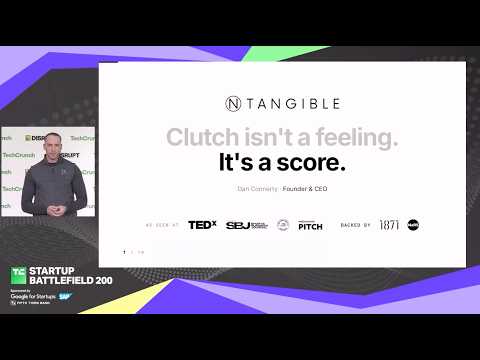 📺 NTangible: Measuring How Athletes Perform Under Pressure | Startup Battlefield 2026
Intangible: Predicting Athlete Performance Under Pressure with Cognitive Assessments
▼
Dan Connelly, founder and CEO of Intangible, presents his company's sports-focused cognitive assessment platfo…
Dan Connelly, founder and CEO of Intangible, presents his company's sports-focused cognitive assessment platform that predicts how athletes perform under pressure. The pitch covers the product demo, its science-based methodology, business model, and expansion plans, followed by a Q&A session with the judges.
■ The Problem & Solution
- Measuring the cost of wrong player decisions and why cognitive skills under pressure remained unquantified
- Introducing the world's first sports-specific verbal cognitive assessment, developed by Dr. Ed Levin
■ Live Product Demo
- Walkthrough of the Clutch Perception Test with real-time scoring outputs
- Three key metrics: Clutch Factor score, Interpretation guide, and Alignment Index
■ Business Model & Traction
- Revenue model combining per-player enrollment fees and annual SaaS subscriptions
- Partnerships with youth softball, the NBA, STATSports, and RFK Racing, plus future expansion beyond sports
■ Judges' Q&A
- Data validation, retest value, regulatory concerns around AI in hiring, and voice-print analysis capabilities
This session is suited for sports tech professionals, coaches, HR and assessment practitioners, and startup investors who want to understand how cognitive analytics is applied to talent selection and what a real-world fundraising pitch looks like.
 📺 TimeTeller: Measuring Your Biological Clock | Startup Battlefield 2026
شركة TimeTeller تعرض تقنية تحديد أفضل وقت للعلاج من خلال اختبار لعاب بسيط في TechCrunch
▼
تعرض مؤسِّسة ورئيسة تنفيذية لشركة TimeTeller، الشركة الناشئة المنشأة من جامعة Charité الطبية، كيف يمكن لقياس ا…
تعرض مؤسِّسة ورئيسة تنفيذية لشركة TimeTeller، الشركة الناشئة المنشأة من جامعة Charité الطبية، كيف يمكن لقياس الساعة البيولوجية للمريض تحسين تحمُّل العلاج وتقليل الآثار الجانبية. يشرح الفيديو التقنية المبنية على تحليل الحمض النووي الريبي من عيّنة اللعاب باستخدام النمذجة الرياضية والذكاء الاصطناعي، مع عرض توضيحي داخل المختبر.
■ المشكلة والحل
- تحدي تحمُّل المرضى للعلاجات مثل علاجات السرطان وعلاجات GLP-1
- استخدام إيقاع الساعة الداخلية لتحديد أفضل وقت لتلقّي العلاج
- اختبار لعاب يقيس RNA لتحديد النمط البيولوجي لكل مريض
■ التقنية والتطبيقات السريرية
- دراسة أُجريت في 10 مستشفيات ألمانية حول سرطان المبيض
- نتائج الدراسة المتعلقة بمستويات السمية وتحمُّل العلاج
- عرض توضيحي لخطوات تحليل العيّنة وبناء الملف الجزيئي
■ نموذج العمل والتوسّع
- الشراكة مع أكبر نظام رعاية صحية في ألمانيا ونموذج الاسترداد
- الترخيص للقطاع الصيدلاني ولقطاعات اللياقة وطول العمر
- الأهداف المالية وخطة جمع التمويل
■ جلسة الأسئلة والأجوبة مع الحُكّام
- نطاق التغطية التأمينية وعلاقتها بالوقاية والعلاج
- تأثير التوقيت على الامتثال للعلاج والأدوية ذات الآثار الجانبية العالية
- نموذج البيع المباشر للمستهلك مقابل الحاجة لوصفة طبية
يُناسب هذا الفيديو المهتمين بالصحة الرقمية والصيدلة الدقيقة والشركات الناشئة في قطاع الطب. يمنح المشاهد فهمًا لكيفية تطبيق علم الأوقات البيولوجية على العلاجات الطبية ونموذج الأعمال المرتبط بها.
 📺 Hiyd AI: Sleep, Movement and Nutrition in One Tiny Wearable | Startup Battlefield 2026
HIDE: A Stealth Health Tracker That Clips Under Any Watch — Pitch & Investor Q&A
▼
HIDE is a discreet health-tracking sensor as thin as a coin that attaches beneath any watch, aiming to deliver…
HIDE is a discreet health-tracking sensor as thin as a coin that attaches beneath any watch, aiming to deliver continuous health insights without changing the wearer's habits. In this pitch, founder Sol Republic walks through the product design, companion app, business model, traction, and team, followed by an in-depth Q&A session with the judges covering competition, pricing, data accuracy, distribution, and women's health tracking.
■ Product & Technology
- How the ultra-thin sensor tracks heart rate, recovery, blood oxygen, sleep, and activity while remaining invisible under a watch
- The friction-free charging mechanism built into the included band, eliminating the need for a nightly charger
- The companion app's three-pillar approach (movement, sleep, nutrition) powering an AI coach that delivers personalized, proactive insights
■ Business Model & Traction
- One-time device purchase of $299 plus an optional $6/month AI and nutrition subscription
- Pre-launch results including pre-orders, waitlist size, deposit count, and ad spend return
- Distribution strategy moving from direct-to-consumer to retail and watch-brand partnerships
■ Investor Q&A
- Comparison with competitors such as Oura Ring and wrist-worn alternatives
- Data accuracy testing methods including benchmarking against major brands and ECG patches
- Plans for women's health tracking, advisory input, and future hardware iterations
■ Team & Fundraising
- Founder and team backgrounds, including experience at Apple and prior startup ventures
- Seed round target, launch milestones, and product ecosystem expansion plans
This pitch is useful for investors, wearable-tech enthusiasts, founders preparing their own pitches, and anyone interested in the health-tracking market. Viewers can learn how a stealth wearable differentiates itself in a crowded category and what questions judges typically raise during a hardware startup pitch. Consider visiting the company's booth at H30 if the presentation resonates with you.
 📺 Mosqitter: Early Warning for Mosquito-Borne Disease | Startup Battlefield 2026
Mosquiter's TechCrunch Disrupt Pitch: AI Mosquito Control and Real-Time Surveillance Platform
▼
Mosquiter co-founder and CEO Anastasia presents the company's eco-friendly mosquito control devices and the Ve…
Mosquiter co-founder and CEO Anastasia presents the company's eco-friendly mosquito control devices and the VebuZ real-time surveillance platform at TechCrunch Disrupt, followed by a live demo from co-founder Olga and a judge Q&A session on business model, customers, and competitive positioning.
■ The Problem and Market
- Mosquito-borne diseases affect roughly 700 million people annually, and climate change and global travel are expanding mosquito species into new regions
- Current responses are largely reactive, with municipal spraying and lab-based trapping still standard practice
■ Products and Deployments
- Mosquiter Grand for commercial clients and Mosquiter Mini for homeowners, deployed across five continents through distributors in Brazil, Greece, Nigeria, Ukraine, and the United States
- Deployments with pest control firms and hotel brands, plus a security screening role at the G20 summit in India
- VebuZ surveillance platform: devices trap mosquitoes, onboard sensors and a neural network identify species such as Aedes aegypti, and location and weather data generate real-time risk forecasts
■ Business and Traction
- Reported revenue of about $1.8 million to date, roughly $1 million expected this year, and a $3.6 million sales pipeline built in two months
- Government and biosecurity customers including the UK Health Security Agency, Nigeria, and the University of Nevada
- Pricing combines one-time equipment fees with recurring data subscriptions after a two-week calibration period
- A portfolio of 14 issued patents, with a $5 million funding round now open
■ Judge Q&A
- Topics include network connectivity via Wi-Fi and 4G LTE, competition from Biogents and Dynatrap, ideal customer segments, sensor density requirements, and the value of online data collection over manual water-bucket sampling
Entrepreneurs, public health professionals, investors, and anyone interested in hardware-plus-data business models or vector-borne disease prevention will find a compact case study of how a startup moves from consumer devices to government-grade surveillance infrastructure.
 📺 GUDEA Maps How Information Spreads | Startup Battlefield 2026
Good Data's Pitch on Detecting Coordinated Online Narratives Before They Go Mainstream
▼
A six-minute pitch by Good Data's VP of Global Sales, Matt Chase, followed by a judge Q&A, presents a platform…
A six-minute pitch by Good Data's VP of Global Sales, Matt Chase, followed by a judge Q&A, presents a platform that tracks how stories spread across roughly 600 social platforms so brands can see forming narratives before they reach mainstream audiences. The talk uses a real-world demo and specific campaign examples to illustrate how coordinated online activity can move markets and brand perception.
■ The Pitch
- Why "cancel culture" narratives are often the end stage of coordinated campaigns rather than organic reaction
- Business impact of online attacks on data-center projects and the global economy
- Live demo: tracing a spike of posts about a chipmaker back to a single niche message board and non-human accounts
- What the product delivers: platform deep-dive analytics plus an executive-ready reporting layer
- Team background in intelligence, national security, politics, and marketing technology, and clients across media, retail, audio streaming, AI research, and music
■ Judge Q&A
- Coverage of 600 platforms, including fringe and mainstream outlets, and how data is aggregated and classified
- How organic versus manufactured content and account behavior are identified, and who decides on response
- Buyer personas: PR/comms, brand marketing, and cyber risk teams, plus political campaigns and B2B organizations in crisis
- Potential uses for hedge funds, quant funds, and influencer due diligence
- B2C versus B2B go-to-market focus and the role of human analysts alongside the data
- Whether government agencies are a viable market
Recommended for brand, PR, communications, marketing, and cyber-risk professionals, as well as founders and investors in the social intelligence space. It offers a concrete view of how early-signal monitoring works, what questions buyers tend to ask, and how teams can move from reacting to incoming mentions toward preparing for what is forming next.
 📺 Floqer Gives AI Agents the Full B2B Customer Timeline | Startup Battlefield 2026
Flocker Pitch: Building a Self-Maintaining Customer Data Platform for AI Agents
▼
This is a TechCrunch Disrupt stage pitch by Flocker, a startup building a customer data platform that maintain…
This is a TechCrunch Disrupt stage pitch by Flocker, a startup building a customer data platform that maintains itself so AI agents can answer business questions reliably. The founder explains why fragmented, outdated business data causes agents to hallucinate, then demos Flocker alongside Claude using the same model to show the difference clean data makes. The session closes with a judge Q&A covering go-to-market, moats, open sourcing, onboarding, and pricing.
■ The Problem
- Business data is always changing: people change jobs, companies shut down, teams get laid off
- Agents connected to unclean, unconnected sources still hallucinate
- HubSpot CEO and Salesforce president have raised the same issue at recent conferences
- Manual CRM/CDP maintenance is an estimated $50B opportunity
■ Product Demo
- Same model (Claude) on both sides: one agent with raw sources fails, Flocker succeeds
- Query asked: customers who signed up but were not contacted this year
■ Core Value Propositions
- Acts as a data router procuring 80+ data vendors
- Agent harness that builds and maintains data pipelines without data engineering effort
- Builds and maintains a customer ontology that models new objects automatically
■ Traction & Team
- Customers include AI and fintech companies such as Perplexity and Wise
- Reported 14% month-over-month compound revenue growth; starting ACVs around $10K with most revenue from expansion
- Team of eight based in Toronto, including former customers and founders
■ Judge Q&A
- Alternatives considered, economic buyer, product surface area expansion
- Enterprise onboarding and data confidentiality, outcome-based pricing, open-source strategy
This is useful viewing for founders, engineering leaders, and go-to-market teams evaluating how AI agents depend on data quality. Viewers can expect to understand the current market framing of agent-ready customer data, what a platform in this category claims to automate, and the commercial and technical questions investors ask about it.
📄 このページの紹介文は AI が独自に生成したものであり、著作権をはじめとする他者の権利(商標権・名誉権・プライバシー等)を侵害しないよう配慮しています。動画の著作権は各作成者に帰属します。