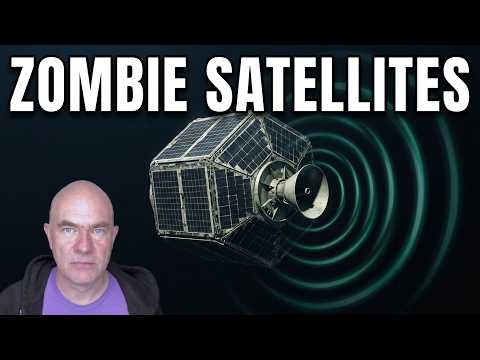
 📺 Spacecraft That Returned From The Dead! Transmissions From Beyond The Grave
Zombie Satellites: How Abandoned Spacecraft Come Back to Life from Beyond the Grave
▼
Long-dead satellites that were abandoned in orbit are sometimes detected transmitting signals again, sometimes decades after falling silent. This video explains why this happens, using real cases to show how battery chemistry and unexpected engineering quirks can revive spacecraft years or even decades after they were written off.
■ Zombie Satellites That Returned on Their Own
- LES-1: a 1965 MIT Lincoln Laboratory test satellite that fell silent in 1967 and was re-detected by radio amateurs in 2012
- Nickel-cadmium battery chemistry: how cadmium growth creates a short, and how it can later break open and restore power to the spacecraft
- AMSAT-OSCAR 7: a 1974 amateur radio satellite that went silent in 1981 and resumed transmitting telemetry in 2002
- IMAGE: a NASA magnetosphere imaging satellite lost in 2005, briefly contacted again in 2018 after a deep eclipse forced a reset
■ A Satellite Revived Deliberately
- BSat-1: a CubeSat from Technical University of Berlin that stopped returning valid data
- Reconstructing a missing engineering model from salvaged parts to test commands
- Uploading software corrections in 4-byte packets during short passes, and a dormant camera unexpectedly producing images
This is suited to viewers interested in space history, amateur radio, satellite engineering, and how real hardware fails and recovers. Watching it gives you a concrete understanding of why "dead" spacecraft can keep working and what it takes to bring one back. Consider looking up the referenced amateur radio satellite organizations and mission archives to explore the topic further.
このチャンネルのほかの紹介

The Unexpected Revival of the AMSAT AO-7 Amateur Radio Satellite
AMSAT's AO-7, the second Phase 2 amateur radio satellite, was launched in November 1974 as a secondary payload…

Keihan Space's Orbital Data Center Rocket: Big Iron, Clydesdale Engines, and the 2028 Goal
Scott Manley reviews the recently announced plans of Keihan Space, formerly Aether Flux, the company founded b…

A New Dwarf Planet Candidate Discovered at the Edge of the Solar System
The Vera Rubin Observatory has identified a new trans-Neptunian object designated 2026 ED138, potentially larg…
この動画を紹介した Scott Manley の最新動画も、紹介付きで読めます。
いつも見ているチャンネルも、同じように紹介できます。
いつも見ているチャンネルを追加する📄 このページの紹介文は AI が独自に生成したものであり、著作権をはじめとする他者の権利(商標権・名誉権・プライバシー等)を侵害しないよう配慮しています。動画の著作権は各作成者に帰属します。