NVIDIA Video Summaries
AI-generated summaries of new videos. A no-sign-up video summary & introduction page
 📺 What does “fungible” mean for AI infrastructure?
Understanding NVIDIA's Feasible AI Infrastructure for Maximizing ROI
▼
This content explains the concept of 'feasible' in the context of NVIDIA's AI infrastructure, detailing how it supports diverse workloads to maximize return on investment. It breaks down the technical layers and operational goals that enable efficient processing.
- Definition of feasible: Running diverse sets of accelerative workloads
- Underlying mathematics: Mapping workloads to parallel calculations using GPUs
- Software layer: CUDA as the programming interface with extensive library support
- Productivity goals: Maximizing throughput per megawatt and minimizing token costs
- Strategic outcome: Increasing revenue and profit margins through scalable infrastructure
Viewers will gain a clear understanding of how NVIDIA structures its AI hardware and software ecosystem to optimize efficiency and financial returns.
 📺 Meet The Startup: Probabl: by the Creators of Scikit-Learn
Scikit-learn's Evolution: GPU Acceleration, Tabular AI Strategy, and Agent Integration
▼
This discussion explores the strategic evolution of Scikit-learn beyond its traditional CPU-based statistical machine learning roots. It highlights the shift towards GPU acceleration for specific algorithms, the goal of becoming a leading tabular AI company, and the integration with agent-driven workflows.
■ Strategic Positioning and Hardware Optimization
- Transition from pure GenAI to statistical machine learning foundations
- Leveraging Scikit-learn's dominance with over 5 billion downloads
- Optimizing total cost of ownership by maximizing intelligence units per gigawatt
■ Technical Infrastructure and Scalability
- Offloading specific estimators to GPUs for enhanced performance
- Building an abstraction layer to ensure seamless deployment across new chip generations
- Avoiding code rewrites through scalable workload management
■ Ecosystem Dynamics and Future Goals
- Projecting to be the global leader in tabular AI within five years
- Engaging with partners like Inception to access specialized expertise
- Adapting to high-volume agent usage, evidenced by 2 billion downloads in the last 12 months
Data engineers, data scientists, and software engineers can gain insights into optimizing machine learning infrastructure for scale and understanding how open-source ecosystems are adapting to the demands of modern AI agents.
 📺 Pause to pick your #NVIDIAGTC Berlin gear. 👀
この動画の紹介が用意できませんでした
▼
 📺 NVIDIA DOCA Skills vs No Skills: Building RDMA on NVIDIA BlueField-3 with Fewer Commands & Less Code
Comparing AI Coding Agents with and without NVIDIA DOCA Skills
▼
This video demonstrates how NVIDIA DOCA skills significantly enhance the efficiency of AI coding agents when building RDMA applications on Bluefield 3 hardware. By comparing two agents—one with pre-installed skills and one without—it highlights reductions in code volume and hardware interaction steps.
- Side-by-side agent comparison for DOCA RDMA tasks
- Impact of skills on command count and discovery speed
- Code reuse versus manual implementation metrics
- Performance across different prompt scenarios
Viewers interested in AI-assisted development and NVIDIA DOCA integration will gain insights into optimizing agent workflows and leveraging supported samples to reduce development overhead.
 📺 Vertically Integrated, Horizontally Open | AI Factory Insider Ep 5
Vertically Integrated, Horizontally Open AI Factories and the Evolution of CUDA
▼
This episode explores the architecture of enterprise AI factories through the lens of vertical integration and horizontal openness, while detailing the foundational role of CUDA in accelerating these systems. Guests Steven Jones and Pradeep Gupta discuss how NVIDIA's platform design enables broad industry applicability and explain the transition from traditional software development to agentic workflows powered by CUDA libraries as skills.
- Vertical Integration and Horizontal Openness: Defining the modular, flexible platform structure that combines performance optimization with ecosystem collaboration across all stack layers.
- Industry Applications and Common Workflows: Examining shared data management and model training flows across diverse sectors like healthcare, finance, and retail, despite specific domain differences.
- CUDA Platform and Libraries: Distinguishing between the core CUDA platform and the extensive suite of optimized libraries (CUDAx), including their history, interoperability, and open standards compliance.
- Hardware-Software Co-Evolution: Analyzing the tight coupling between GPU hardware roadmaps (Hopper, Blackwell, Vera Rubin) and software advancements to ensure backward compatibility and performance gains.
- Agentic AI and Developer Impact: Discussing the announcement of CUDA libraries as skills for AI agents, and how this shift transforms developer roles into agent management and system design.
 📺 10 Years of NVIDIA DGX
The Evolution of NVIDIA DGX and the Modern AI Factory
▼
This content explores the decade-long journey of NVIDIA's hardware infrastructure, tracing the origins of modern AI computing from early experimental setups to standardized industrial solutions. It highlights the pivotal introduction of the NVIDIA DGX 1 system and its revolutionary NVLink networking technology as the foundation for scalable AI research.
- Origins of AI Hardware: The initial efforts by researchers to piece together equipment for breakthrough work ten years ago.
- The Need for New Systems: The realization that existing architectures were insufficient for next-generation GPUs and challenging AI experiments.
- Introduction of NVIDIA DGX 1: The launch of a system based on a brand-new interconnect (NVLink) designed to power new waves of AI.
- Evolution into the AI Factory Blueprint: How a single system evolved over ten years into the standard blueprint for modern AI factories.
Viewers interested in the history of deep learning infrastructure and enterprise AI hardware will gain insight into how foundational technologies shaped current computational capabilities.
 📺 10 Years of NVIDIA DGX: From One System to AI Factories
The Evolution of NVIDIA DGX: A Decade of AI Infrastructure Innovation
▼
This content traces the ten-year journey of NVIDIA DGX systems, highlighting their evolution from a single breakthrough server to the blueprint for modern AI factories. It details how these systems have enabled major advancements in deep learning, autonomous agents, and industrial AI through continuous architectural improvements.
- Early Breakthroughs (2016-2017): Introduction of DGX-1 with NVLink and its role in early deep learning milestones at OpenAI and Meta.
- Scaling Infrastructure: Deployment of DGX SuperPOD for large-scale clusters and achievements on TOP500/Green500 lists.
- Architectural Shifts: Transition to Hopper and Blackwell architectures focusing on massive context memory and complex decision engines.
- Industry Applications: Use cases in public sector (MITRE), finance (BNY), pharmaceuticals (Lilly), translation (DeepL), and manufacturing (Foxconn).
- Next-Generation Systems: Overview of Grace Blackwell, DGX Spark for developers, and Vera Rubin rack-scale systems for agentic AI.
This overview provides a historical perspective on AI hardware development and illustrates the practical impact of NVIDIA's infrastructure solutions across various sectors.
 📺 NVIDIA CEO Jensen Huang on The Ezra Klein Show
Responsible Optimism: Channeling Worry into Technology Benefits
▼
This content explores the concept of 'responsible optimism,' where deep concerns about future challenges are transformed into rigorous work to ensure technology serves society positively. It emphasizes taking extreme responsibility for technical complexities so that end-users can enjoy the benefits without bearing the burden of underlying difficulties.
- The philosophy of responsible optimism and its role in leadership
- Managing anxiety by treating societal problems as personal responsibilities
- Applying serious work ethics to family and children alongside professional duties
- Directing worry towards inspiring others and ensuring technology benefits users
Viewers interested in tech leadership, mental resilience, and ethical technology development will gain insights into balancing high-stakes responsibility with positive outcomes.
 📺 We got @unsloth a DGX Station!
Nvidia and Unsloth Collaboration on High-Performance Quantization and Reinforcement Learning
▼
This video features a discussion between Nader from Nvidia and Daniel from Unsloth regarding the utilization of the DGX Station for advanced AI model optimization. The conversation highlights the partnership's focus on accelerating quantization processes and enhancing reinforcement learning efficiency through high-bandwidth hardware solutions.
■ Key Discussion Points
- Introduction of the DGX Station and its role in overcoming bandwidth constraints
- Plans to expand quantization support for various models requested by the community
- Goals to make reinforcement learning faster and more efficient using the new hardware
- Commitment to providing increased resources and tools for open-source development
Viewers interested in AI infrastructure, model quantization techniques, and the synergy between Nvidia hardware and Unsloth software will gain insights into current industry trends and collaborative efforts aimed at improving computational efficiency.
 📺 How businesses can use AI and keep their data private
Unlocking AI in Regulated Industries with Confidential Computing
▼
This content addresses the critical challenge of deploying artificial intelligence within highly regulated sectors such as healthcare, finance, and government. It explains how organizations can leverage confidential computing to utilize proprietary data without compromising security or regulatory compliance.
- The conflict between enterprises' need to retain data and model builders' desire to protect weights
- Regulatory barriers preventing the movement of sensitive data (healthcare records, financial transactions) to the cloud
- The solution of bringing the model down to the data center
- How encrypted model weights are processed without being decrypted or visible to data center operators
Viewers will gain an understanding of secure AI deployment strategies for sensitive environments. This overview is suitable for professionals in regulated industries seeking to implement AI while maintaining strict data confidentiality.
 📺 Why the AI Ecosystem Builds on NVIDIA - Jensen Huang at the All-In Summit
Nvidia's Dominance in the Global AI Model Ecosystem
▼
This content explores Nvidia's strategic position as the foundational infrastructure provider for a rapidly expanding array of frontier artificial intelligence models. It highlights the shift from exclusive partnerships to an inclusive platform strategy that supports diverse AI labs.
- Expansion of Supported Models: Details the transition from running only OpenAI to supporting Meta Muse, Grok, Gemini, and Anthropic.
- Growth of AI Labs: Discusses the increasing number of companies building frontier models on Nvidia's platform.
- Strategic Philosophy: Explains Nvidia's approach of helping all developers succeed rather than competing for market share.
Viewers interested in the current state of AI infrastructure and corporate strategies in the technology sector will gain insight into how hardware providers are adapting to a multi-model future.
 📺 Build Custom AI Infrastructure with NVIDIA NVLink Fusion
NVIDIA NVLink Fusion: A Unified Platform for Custom XPUs and AI Factories
▼
This video introduces NVIDIA NVLink Fusion, a platform designed to connect custom XPUs and CPUs to the NVIDIA AI infrastructure. It explains how this technology addresses the challenges of deploying specialized AI chips at scale by providing a standardized rack-scale architecture.
■ Key Components of NVLink Fusion
- Integration of NVLink scale-up networking, Photonics, NVHBM, and NVLink-C2C
- Built on the proven MGX rack-scale architecture
■ Benefits for Silicon Innovators
- Increased performance and faster time-to-market
- Lower deployment risk and support for both XPUs and GPUs in the same AI factory
■ Partner Perspectives
- NVIDIA platform is vertically integrated but horizontally open
- Focus on custom compute while leveraging NVIDIA's proven infrastructure
This video is intended for technology professionals and decision-makers interested in AI infrastructure and custom chip deployment. Viewers will gain an understanding of how NVLink Fusion can streamline the creation of AI factories and reduce integration challenges.
 📺 AI-RAN: 5 Things to Know
Understanding AI-RAN: The Future of Intelligent Mobile Networks
▼
This content explores the concept of AI-RAN (Artificial Intelligence in the Radio Access Network) and its potential to transform mobile connectivity. It details how integrating AI directly into network infrastructure creates a shared, software-defined platform that enhances performance and opens new monetization opportunities.
- Shared Infrastructure: Utilizing general-purpose systems for both RAN and AI workloads instead of separate dedicated systems.
- Software-Defined Innovation: Enabling rapid updates and improvements through software rather than waiting for hardware refreshes.
- Performance Optimization: Using advanced algorithms to predict network behavior, improve spectral efficiency, and reduce congestion.
- Monetization at the Edge: Supporting low-latency services like robotics and autonomous systems through edge AI inference.
- Real-World Deployment: Moving from lab concepts to field trials with major operators such as T-Mobile and SoftBank.
This overview is suitable for those interested in telecommunications technology and 6G readiness. Viewers will gain a clear understanding of how AI-RAN builds an AI-native foundation for future networks.
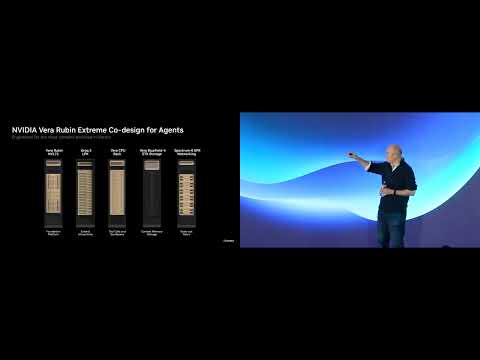 📺 Advancing Infrastructure for the Era of Agentic AI | Ian Buck at AI Infra Summit 2026
Advancing AI Infrastructure for the Era of Agentic AI
▼
This video discusses the evolution of AI infrastructure, focusing on the demands of agentic AI and NVIDIA's latest innovations. It explains how the Vera Rubin platform, along with new CPUs, networking, and software, is designed to handle the complex workloads of AI agents, offering significant performance and efficiency gains.
■ The Shift to Agentic AI
- The changing nature of AI workloads, from simple chat interactions to complex agentic tasks
- The increased demands on compute, memory, and networking for agentic AI
■ Vera Rubin: The Next-Generation AI Platform
- Overview of the Vera Rubin platform and its components (GPU, CPU, networking, storage)
- Performance improvements in AI factory throughput and cost per token
■ Innovations for Agentic Computing
- The Vera CPU for fast tool calling and low-latency performance
- NVLink Fusion for scaling AI infrastructure
- MaxLPS for optimizing data center power and increasing compute density
■ Real-World Impact and Adoption
- Benchmark results and early customer deployments (e.g., Perplexity, Clickhouse)
- Partnerships and availability of the new technologies
This video is for data center operators, cloud providers, and technology enthusiasts interested in the future of AI infrastructure. Viewers will gain insights into the challenges of agentic AI and the strategies NVIDIA is employing to address them, including hardware and software co-design.
 📺 The Infrastructure of Intelligence: NVIDIA and OpenAI on a Decade of Building Frontier AI
Building AI Infrastructure at Scale: Insights from OpenAI and NVIDIA
▼
This video features a discussion between Sachin and Ian from OpenAI and NVIDIA on the challenges and innovations in building AI infrastructure at scale. They cover the shift from single-GPU to data-center-scale compute, the co-design of power and cooling systems, and the use of AI models to optimize hardware and software.
■ AI Infrastructure Evolution
- From GPU to data center scale
- Compute as a token factory
- Heterogeneous systems and orchestration
■ Data Center Design Innovations
- Gigawatt-scale projects like the Ohio Data Center
- Dynamic power load balancing
- Grid stabilization and efficiency
■ AI in Hardware and Software Optimization
- Using AI for kernel optimization (e.g., Astra on Vera Rubin)
- AI in chip design and bug analysis
- Developer tools and agent-based workflows
■ Partnerships and Future Outlook
- Collaboration between OpenAI and NVIDIA
- Compute needs for safety and alignment
This video is intended for technology professionals, engineers, and decision-makers interested in the future of AI infrastructure. Viewers will gain insights into the technical and strategic considerations behind building and operating large-scale AI systems, as well as the role of AI in optimizing hardware and software.
📄 このページの紹介文は AI が独自に生成したものであり、著作権をはじめとする他者の権利(商標権・名誉権・プライバシー等)を侵害しないよう配慮しています。動画の著作権は各作成者に帰属します。