NVIDIA Video Summaries
AI-generated summaries of new videos. A no-sign-up video summary & introduction page
 📺 Meet the Startup: Aegiq, A Full-Stack Photonic Quantum Computing Company
Scaling Photonic Quantum Computers with NVIDIA Technologies
▼
A quantum computing company shares its mission to deploy photonic quantum computers at scale through compact d…
A quantum computing company shares its mission to deploy photonic quantum computers at scale through compact design, fiber interconnection, and standard semiconductor manufacturing, and explains how NVIDIA tools support that effort. The discussion covers calibration workflow improvements and large-scale simulation workloads, with concrete examples of current capabilities and collaboration goals.
■ Photonic Quantum Computing
- Reducing system size and interconnecting quantum computers with standard fiber networking
- Building on standard semiconductor manufacturing for easier deployment
■ NVIDIA Integration
- Adopting NVIDIA Ising within the calibration workflow to shorten quantum dot calibration time
- Utilizing NVIDIA Inception for customer access and support
- Applying cuTENSOR libraries to deploy GPU-based simulations quickly
■ Large-Scale Simulation
- Computational fluid dynamics mesh sizes compared with state-of-the-art GPU workloads
- Ongoing collaboration targets for larger mesh scales
- Application areas: aerospace, fusion, materials simulation, and quantum chemistry
The content suits professionals and researchers in quantum computing, HPC, and simulation who want to understand how NVIDIA technologies are applied in production workflows. Viewers can gain a clearer picture of deployment challenges, practical tool usage, and the direction of simulation-driven discovery, and can use it as a reference for evaluating similar technology partnerships.
 📺 NVIDIA Alpamayo 2 Edge is here, bringing adaptive AI reasoning in real-time to the vehicle. 🚘
この動画は短いため紹介が用意できません
▼
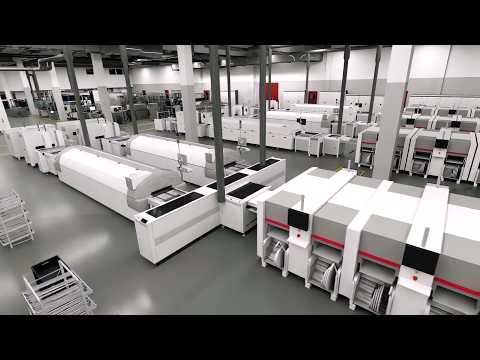 📺 How Siemens Plans Production in Minutes With NVIDIA AI
Siemens and NVIDIA Showcase AI-Powered Adaptive Manufacturing with Digital Twins and Agents
▼
Siemens and NVIDIA demonstrate how AI agents and digital twins are transforming manufacturing at an electronic…
Siemens and NVIDIA demonstrate how AI agents and digital twins are transforming manufacturing at an electronics factory in Erlangen. The presentation covers how adaptive, AI-driven tools accelerate production planning, quality inspection, and optimization for high product variation.
■ AI-Driven Quality Control
- Virtual prototype generation and synthetic data training to replace physical prototypes
- In-context learning to adapt inspection models when components change unexpectedly
■ Intelligent Production Planning
- Agents that recommend production plans balancing orders, supplies, and line setups
- Physics-based simulation combined with real-time data to validate plans
■ Platform Integration
- Siemens Process Preparation X, Intelligence Center X for Operations, and Digital Twin Composer
- NVIDIA Cosmos, Factory Operations Blueprint, and Omniverse Libraries
Manufacturing engineers, production planners, and professionals interested in smart factory technologies will find a concrete overview of how AI agents and digital twins are applied on the factory floor. The content offers a practical reference for understanding the scope of adaptive manufacturing solutions and where such tools may fit into existing workflows.
 📺 From AI Infrastructure to the 6G Future
NVIDIA on Telecom's AI Transformation: AI RAN, Software-Defined Networks, and the Road to 6G
▼
This session outlines how artificial intelligence is reshaping telecommunications, from repurposing existing n…
This session outlines how artificial intelligence is reshaping telecommunications, from repurposing existing network power and connectivity assets to building AI factories and re-architecting the radio access network. The speaker walks through concrete deployments, product announcements, and partner case studies that illustrate where the industry currently stands.
■ AI Infrastructure and Telco Transformation
- Operator AI factory buildouts across North America, Asia, and Europe
- Distributed edge compute and latency-sensitive applications
- Autonomous agentic network operations
■ Software-Defined RAN and AI RAN
- New MGX systems and the Aerial RAN computer family
- Operator trials, commercial calls, and the AI RAN Alliance ecosystem
- National initiatives for next-generation wireless infrastructure
■ 6G Research and Developer Ecosystem
- Open-source Sionna and Aerial tooling, plus the 6G developer program
- Agent-driven testbed and digital-twin based research workflow
■ Domain Models for Network Operations
- Post-trained Neotron models applied to troubleshooting, site surveys, and fault prediction
- Nokia partnership progress and spectral efficiency work
Telecom engineers, network architects, AI infrastructure planners, and industry analysts will gain a clear picture of which transformations are already underway and which capabilities are being deployed today. After watching, consider exploring the referenced open-source tools and the on-site innovation platform to evaluate how these approaches could apply to your own network or research work.
 📺 Your Spark, Your Story: Yannik Marek | NVIDIA RTX Spark
Comfy UI Creator on Building the Tool and Running Models on RTX Spark
▼
The original creator of Comfy UI shares how the project began in January 2023 as an open-source tool built to …
The original creator of Comfy UI shares how the project began in January 2023 as an open-source tool built to give users more control over their AI experiments, and reflects on what shaped his interest in computing from a young age.
■ Origins of Comfy UI
- The motivation behind creating the project and its focus on user control
- How an early experience with video games on CRT monitors sparked an interest in computing
■ Hardware for running models
- What Comfy UI requires to run its supported models
- How RTX Spark provides the power and memory to run them, including its compact laptop form factor
- A reflection on how much computing power fits into a small, light device
This is suited for viewers who want to tinker with Comfy UI and are considering the hardware needed to run its models. It offers background on the tool's development goals and an overview of the hardware that supports it.
 📺 The robots were told there’d be candy. 🍬🎃
この動画は短いため紹介が用意できません
▼
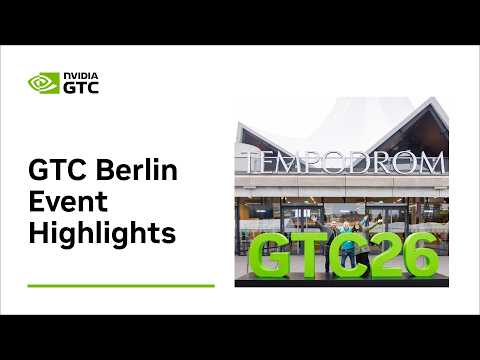 📺 NVIDIA GTC Berlin 2026 Event Highlights: AI in Action Across Europe
NVIDIA GTC Keynote on Building Europe's AI Economy
▼
This keynote addresses the emergence of a new industrial revolution driven by AI, focusing on Europe's ambitio…
This keynote addresses the emergence of a new industrial revolution driven by AI, focusing on Europe's ambition to not only consume but also produce AI. It covers investment announcements across European countries, the transformation of industries, and the region's strengths in precision engineering and manufacturing.
■ Europe's AI Economy
- Investments announced across France, the UK, Sweden, and Berlin, covering 14 startup companies
- The importance of producing AI, not just consuming it
- A new generation of companies being built around AI from day one
■ Industry Transformation
- The expected impact of AI on healthcare and life sciences
- How every person, company, and industry will be affected by AI
- Europe's expertise in mechatronics, electronics, and mechanical systems
The keynote is aimed at professionals, business leaders, and policymakers interested in AI adoption and regional AI development strategies. Viewers will gain an overview of current AI investment trends in Europe and the strategic positioning of the region in the global AI economy. Those planning AI-related business initiatives in Europe may find the discussion of the regional ecosystem particularly relevant.
 📺 NVIDIA Halos SAFE: Autonomous Vehicle Safety Evaluation From Road Testing to Simulation
Introducing NVIDIA Halos SAFE: A Safety Assurance Framework for Autonomous Driving
▼
NVIDIA Halos SAFE, the Safety Assurance Framework for Evaluation, connects road testing, simulation, and fleet…
NVIDIA Halos SAFE, the Safety Assurance Framework for Evaluation, connects road testing, simulation, and fleet data into a single safety loop. The announcement is framed around the Mercedes-Benz CLA, powered by NVIDIA Hyperion and Halos, which was named Euro NCAP's Best Performer of 2025 with the year's highest overall safety score. The session walks through how continuous safety validation is carried out from real-world test tracks to simulation and back into development.
■ Overview
- The role of evidence in proving vehicle safety, from L2 driver assistance to L4 robotaxis
- NCAP test suites and safety evaluations across worldwide markets
■ The Safety Loop
- Capturing driving scenarios on the test track to establish ground truth
- Reconstructing scenes with NVIDIA Omniverse NuRec and reproducing them in simulation
- Comparing simulated vehicle responses against track measurements
- Reusing validated simulations to test new software releases
■ Hardware and Real-World Testing
- Hardware-in-the-loop simulation with NVIDIA DRIVE AGX Thor
- Real cars tested against virtual hazards using simulated sensor inputs in real time
- Safety-target measurement, feeding results back into development
■ Scenario Expansion
- NVIDIA Cosmos generating thousands of offline variations in lighting, weather, road surfaces, and traffic
- Continuous validation as evidence for certification across markets
This is useful for engineers, safety and certification professionals, and anyone evaluating autonomous driving technology. Viewers can expect to understand the structure of a modern safety validation workflow and how each tool fits into it, then apply that framework when assessing their own testing or compliance plans.
 📺 From Berlin to your living room. 🌍
この動画は短いため紹介が用意できません
▼
 📺 Power Demand, Increasing Grid Reliability and Resiliency
GTC Panel: How AI, Data, and Partnerships Strengthen Europe's Power Grids
▼
At GTC, NVIDIA's global energy lead moderates a discussion with leaders from two of Germany's largest grid ope…
At GTC, NVIDIA's global energy lead moderates a discussion with leaders from two of Germany's largest grid operators and Siemens Energy about the pressures facing European electricity networks. The panel covers physical and cyber threats, surging demand, renewable integration, and how AI and data are being applied to plan, operate, and protect critical energy infrastructure.
■ Distribution and Transmission Challenges
- E.ON's Bayernwerk on 15 years of the energy transition: over a million decentralized renewable generation plants and a highly distributed system
- TenneT on the three parallel challenges: building the grid at scale, running it with rising renewable capacity, and securing it amid geopolitical change
- Siemens Energy on global demand growth from data centers, electrification, and industrialization
■ Security and Resilience
- Physical protection limits of wide-area infrastructure, plus drones, cameras, and anomaly detection
- The growing cyber dimension: attacks, social engineering, disinformation, and the human factor across thousands of employees
- Lessons from real incidents, including a months-long disconnection from a key service provider and sabotage of high-voltage structures
■ Technology and Collaboration
- Adapting self-driving car perception technologies for grid monitoring and integrating them into simulation engines and control rooms
- Digital twin development across design, manufacturing, and operational use cases, and why use-case definition comes first
- Early adoption of NVIDIA's open agent security platform and its relevance for critical infrastructure
■ The Road to 2030
- Operator perspectives on grid autonomy, real-time operation, flexibility, and human-in-the-loop limits
- Near-term priorities: unlocking siloed data, asset digitalization, and shifting organizational mindsets
The session is suited to energy professionals, utility and infrastructure operators, and those interested in the application of AI to industrial systems. Viewers can expect a clear picture of current grid pressures and the concrete ways operators and manufacturers are working with AI to address them, along with a realistic view of what remains ahead.
 📺 Designed in Berlin, for GTC Berlin.
この動画は短いため紹介が用意できません
▼
 📺 How AI Is Advancing Human Health
NVIDIA GTC Healthcare Keynote: Agentic AI, Medical Robotics, and Protein Design with RFD4 Proteina
▼
Kimberly Powell, NVIDIA's Vice President of Healthcare and Life Sciences, presents how agentic AI and physical…
Kimberly Powell, NVIDIA's Vice President of Healthcare and Life Sciences, presents how agentic AI and physical AI are converging to transform healthcare delivery, medical robotics, and drug discovery. The session covers real-world partnerships, platform announcements, and a new protein design model at the frontier.
■ Agentic AI in Healthcare
- Survey insights on adoption speed and ROI of agentic systems in healthcare
- Voice-driven clinical workflows through partners such as Sword Health, Heidi, and Corti
- Making healthcare data AI-ready with secure, sandboxed agent runtimes
■ Physical AI and Medical Robotics
- Isaac for Healthcare platform for hospital automation and clinical robots
- Holoscan 5 real-time runtime and Holoscan Sensor Bridge for edge computing
- Siemens Healthineers collaboration on adaptive radiotherapy workflows
- Open X dataset for hospitals to support robotics training
■ Drug Discovery and Biology Foundation Models
- BioNeMo Agent Toolkit and autonomous lab partnerships with Danaher and Laya Sciences
- RFD4 Proteina, a protein design model co-developed with the University of Washington
- Open-source developer examples and multi-model scientific agent architectures
医療・ライフサイエンス分野でのAI活用に関心のある技術者、研究者、および医療イノベーションに関わる方に向けて、具体的なパートナーシップやプラットフォーム発表を通じて、Agentic AIとPhysical AIの実装状況を把握できます。
 📺 Ten years. A Millionfold Leap in AI.
この動画は短いため紹介が用意できません
▼
 📺 AI in the UK: Drug Discovery, Robotics and AI Factories | NVIDIA
NVIDIA's Vision for the UK: Building the Next Industrial Revolution with AI
▼
This presentation outlines NVIDIA's long-standing relationship with the United Kingdom and its vision for an A…
This presentation outlines NVIDIA's long-standing relationship with the United Kingdom and its vision for an AI-driven industrial revolution. It traces the company's history from early chip design in Bristol to the invention of the GPU and CUDA, then connects that legacy to today's full-stack AI computing platform and AI factories.
■ NVIDIA's History in the UK
- Early chip design collaboration in Bristol and the founding vision
- Milestones including the GPU and CUDA, and their impact on developers and AI
■ Honoring British Scientific Legacy
- Robotics platform named after Isaac Newton
- GPU architecture named after Alan Turing
■ The New Industrial Revolution with AI
- AI factories and accelerated computing as essential infrastructure
- Full-stack AI platform and CUDA-X ecosystem across industries
■ AI at Work Across the UK
- Drug discovery in life sciences
- Robotics and logistics applications
- New tools for voice and video
- New AI factories being built across the country
It is intended for viewers interested in AI infrastructure, the semiconductor industry, and technology's role in society. Viewers can gain an understanding of NVIDIA's positioning in the UK and the breadth of industries AI is expected to reach, and may consider exploring the mentioned platforms and initiatives further.
📄 このページの紹介文は AI が独自に生成したものであり、著作権をはじめとする他者の権利(商標権・名誉権・プライバシー等)を侵害しないよう配慮しています。動画の著作権は各作成者に帰属します。