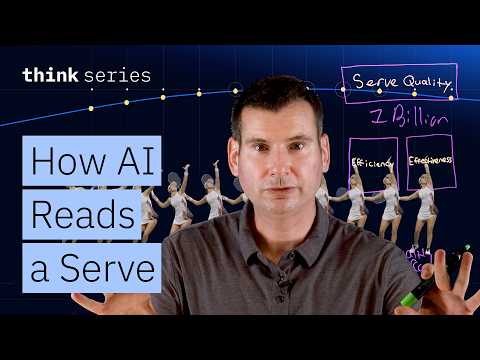
 📺 How AI Agents, LLMs & APIs Use Real-Time Data at the US Open
The Role of APIs in AI Agents for Real-Time Sports Analysis
▼
This content explores the architectural necessity of connecting Large Language Models to specialized APIs, using real-time tennis serve analysis at the US Open as a primary case study. It demonstrates how dividing labor between specialized data processing services and LLMs enables accurate, context-aware responses that pure models cannot achieve alone.
■ Core Concepts and Limitations of Standalone AI
- Why standalone LLMs struggle with real-time accuracy due to stale training data
- The distinction between outcome-based stats (aces, speed) and biomechanical mechanics
- Limitations of raw video input without specialized measurement systems
■ The API Solution: Biomechanics and Effectiveness
- How courtside cameras track ball, racket, and player joints to generate massive datasets
- Processing one billion data points into Efficiency (biomechanics) and Effectiveness (outcomes) scores
- Using IBM Bob to weigh metrics based on kinetic chain research
■ Technical Implementation and Agent Workflows
- Handling high-frequency coordinate data (3,000+ numbers per second) via backend services
- Reducing complex raw data to kilobytes of structured information for LLM context windows
- The agent loop: tools, definitions, and iterative reasoning to answer user queries
■ Broader Applications Beyond Sports
- Applying this pattern to other domains like production outage investigations
- Combining monitoring and log APIs for engineering tasks
- The value proposition of separating heavy computation from natural language reasoning
This guide is suitable for developers and AI enthusiasts interested in system architecture, demonstrating how to build robust agents that leverage external data sources for precise, actionable insights.
この動画を紹介した IBM Technology の最新動画も、紹介付きで読めます。
📄 このページの紹介文は AI が独自に生成したものであり、著作権をはじめとする他者の権利(商標権・名誉権・プライバシー等)を侵害しないよう配慮しています。動画の著作権は各作成者に帰属します。