 動画紹介 SubChan トップ
Google DeepMind Video Summaries
AI-generated summaries of new videos. A no-sign-up video summary & introduction page
 📺 How AI is transforming weather prediction
How AI Is Revolutionizing Weather Forecasting: Inside Google DeepMind's Weather Next
▼
In this episode, we explore how Google DeepMind is applying artificial intelligence to one of science's oldest and most complex challenges: weather prediction. The conversation covers the journey from early AI weather models to the latest system, Weather Next, and how these tools are already making a real-world difference in forecasting extreme events.
■ Hurricane Melissa case study
- How AI predicted a Category 5 storm earlier than other models
- Partnership with the National Hurricane Center
■ Evolution of AI weather models
- From GraphCast to GenCast and probabilistic forecasting
- Differences from traditional numerical weather prediction
■ Weather Next 3 and real-world applications
- Using raw satellite and station data
- Benefits for energy, agriculture, and disaster preparedness
This episode is for anyone curious about how AI is tackling one of science's oldest challenges and what it means for the future of weather prediction. Viewers will gain insight into the capabilities, limitations, and potential of AI-driven weather forecasting.
 📺 AlphaGenome Atlas: Using AI to find disease causing variants 🧬
Alpha Genome: AI-Powered Variant Effect Prediction
▼
Understanding the genome is like understanding the language of life, and Alpha Genome provides a model to predict the impact of single mutations within genomic sequences. This platform leverages artificial intelligence to accelerate scientific progress by offering comprehensive variant effect predictions.
- Alpha Genome Model: Predicts outcomes of single mutations in specific genome regions.
- AVI Score Calculation: Combines predictions into a single number indicating how deleterious or impactful a variant is.
- Pre-computed Data: Covers all 9 billion possible single-letter changes for immediate access.
- Alpha Genome Atlas: A user-friendly website designed to make these predictions accessible to biologists without coding proficiency.
- AI in Research: Demonstrates how AI fundamentally changes research methods and speeds up scientific discovery.
- Empowering Scientists: Aims to give researchers the tools to tackle major challenges facing humanity.
This content is suitable for scientists and biologists interested in leveraging AI for genomic analysis. Viewers will gain insight into how pre-computed variant effects can streamline research processes.
 📺 AlphaGenome Atlas: Understanding the human genome
Understanding the Genome: AI Models and Variant Impact Prediction
▼
We explain how AI models help interpret the human genome and predict the effects of genetic mutations. The focus is on the AVI score, a single metric for assessing variant impact, and the Alpha Genome Atlas platform for exploring genome-wide predictions.
■ AI and the Genome
- How whole genome sequencing and genetic changes relate to human traits
- The challenge of interpreting vast amounts of genomic information
■ Predicting Variant Impact
- The AVI score as a combined measure of how harmful a genetic change may be
- Using AI predictions to prioritize potentially disease-causing variants
■ Alpha Genome Atlas
- A platform for exploring variant effect predictions
- A web-based genome browser designed for researchers without coding expertise
This is suited for biologists, geneticists, and anyone interested in AI-driven genomic research. Viewers will gain an understanding of how variant impact scores are generated and how they can be used to interpret the genome.
 📺 WeatherNext 3: More accurate, timely, and local weather forecasts
Weather Next 3: AI-Powered Global Weather Forecasting at 5 km Resolution
▼
This video introduces Weather Next 3, Google's latest AI-powered global weather model. It explains how the model combines real-time observations with machine learning to produce hourly forecasts at up to 5 km resolution, addressing the limitations of traditional physics-based forecasting.
■ From physics-based to AI forecasting
- Traditional models are expensive and trade off resolution for global coverage
- AI learns from historical observations to deliver faster, more accurate forecasts
■ Weather Next 3 features and uses
- Hourly updates with up to 5 km resolution using real-time satellite data
- Predicts temperature, humidity, wind, pressure, and precipitation
- Adds wind and solar metrics for renewable energy
- Available on Google Search, Gemini, and Maps
Viewers interested in AI applications in meteorology or the practical impact of high-resolution weather data will learn how Weather Next 3 works and where it can be applied.
 📺 The mathematics of AI uncertainty
Why AI Needs Uncertainty: A Conversation with Google DeepMind's Zoubin Ghahramani
▼
In this podcast episode, we explore the critical role of uncertainty in artificial intelligence with Zoubin Ghahramani, professor at Cambridge and co-lead of frontier AI at Google DeepMind. The conversation examines why AI systems must represent and reason about uncertainty to make safe, reliable decisions, and how Bayesian thinking can help.
■ The case for uncertainty in AI
- Why decision-making requires representing uncertainty
- Different types of uncertainty and probability theory
■ Uncertainty in current AI systems
- Overconfidence and adversarial examples
- Large language models and hallucinations
■ Bayesian thinking and real-world applications
- How Bayesian updating models learning and perception
- Weather forecasting and AlphaFold as examples
This episode is for anyone interested in AI safety, machine learning research, or the philosophical questions behind intelligent systems. Viewers will gain a clearer understanding of why uncertainty is a key ingredient for trustworthy AI.
 📺 Talking to Apollo about Gemini Robotics 2 🤖
Gemini Robotics Progress: Tackling Complex Household Challenges
▼
This content explores the latest advancements in Gemini Robotics, focusing on the system's performance across various domestic and physical tasks. It highlights specific challenges such as kitchen chores, sports-related balance, and collaborative garage work, offering insights into current robotic capabilities.
- Kitchen Chores: Analysis of complex tasks like tying trash bags.
- Physical Control: Evaluation of body control and balance through sports challenges.
- Collaborative Tasks: Review of successful cooperation with Duo in messy environments.
- Future Applications: Discussion on potential roles beyond daily assistance, including media interaction.
Viewers interested in robotics development and AI task mastery will gain an understanding of current operational limits and successes in real-world scenarios.
 📺 This is Gemini Robotics 2 🤖
Gemini Robotics 2: Whole-Body Control, Dexterous Manipulation, and Multi-Robot Collaboration
▼
This content explores the latest advancements in Gemini Robotics 2, highlighting how AI models serve as the central nervous system for humanoid robots. It details three core capabilities: coordinated whole-body control, dexterous hand manipulation, and simultaneous multi-robot collaboration to handle complex tasks.
■ Core Capabilities of Gemini Robotics 2
- Whole-body control: Coordinated movement decisions across the entire robot body to achieve natural motion.
- Dexterous hands: AI-driven management of 22 separate joints for precise object manipulation.
- Multi-robot collaboration: Enabling multiple robots to work together simultaneously on shared tasks.
This overview is suitable for those interested in the intersection of AI and robotics, providing insight into how intelligent systems react to changing scenes and accomplish general-purpose tasks.
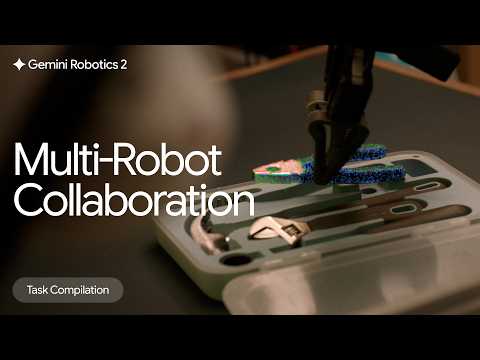 📺 Robots working together with Gemini Robotics 2
A Simple Cleanup Routine: Putting Toys and Tools Away
▼
This video shows a straightforward cleanup routine, demonstrating how to return everyday items to their designated storage spots. The focus is on simple, repeatable actions that help keep a space organized.
■ Putting Away Cleaning Supplies
- Place the scrubbing mitt and spray bottle on the top shelf
■ Organizing Toys
- Put the purple toy into the blue toy box on the top shelf
- Pick up the green watering can from the gray crate on the table
■ Storing Tools
- Keep all tools in the bin, close the kit, and return the kit to the bin
This video is suitable for young children and anyone developing basic organizational habits. Viewers can follow the steps to practice tidying up and learn where items belong.
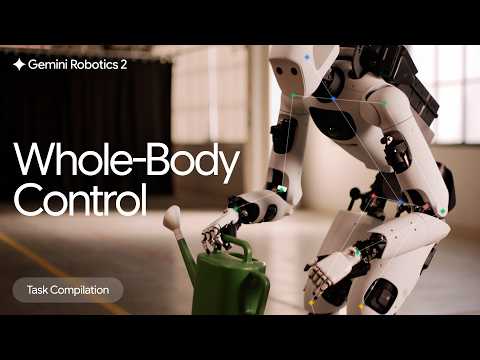 📺 Tasks that require whole-body control with Gemini Robotics 2
White Noise Only – No Spoken Content
▼
The transcript contains only white noise, with no speech, dialogue, or identifiable topics. There is no substantive material to summarize or evaluate, and no products or recommendations are made.
- No topics are covered
Viewers will not gain any informational content from this material.
 📺 Tough dexterity tasks with Gemini Robotics 2
Video with No Speech
▼
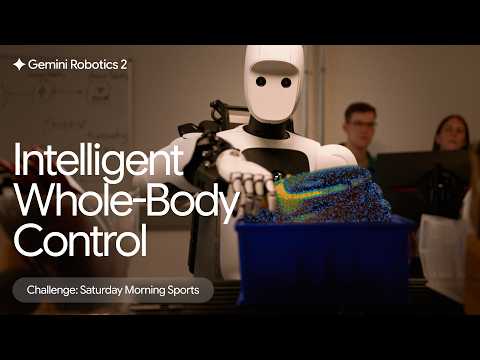 📺 Intelligent whole-body control with Gemini Robotics 2
Gemini Robotics: Whole-Body Control for Real-World Robot Tasks
▼
This video demonstrates how the Gemini Robotics embodied reasoning model enables a humanoid robot to understand natural language instructions and visual scenes, then coordinate its entire body to perform complex tasks in a real-world environment.
- Robot helping pack sports equipment for children's activities
- Integration of embodied reasoning with a vision-language-action model for whole-body control
- Navigating cluttered environments, retrieving objects, and placing them correctly
- Recognizing failures and retrying, plus a reactivity stress test with an unexpected object
This video is suitable for those interested in robotics, AI, and embodied reasoning, offering a look at how generalist robots may handle useful real-world tasks.
 📺 Multi-robot collaboration with Gemini Robotics 2
Gemini Robotics 2: Multi-Robot Collaboration and Precision Control
▼
This video introduces Gemini Robotics 2, a system that enables multiple robots to work together on the same task simultaneously. It demonstrates how robots coordinate through high-level reasoning, communicate with each other, and maintain precise control during collaborative operations.
■ Multi-robot collaboration
- Two robots cooperating on a shared tidying and organization task
- Task planning and handover between robots
■ Precision and control
- Fine motion control for gripper and bi-arm robots
- Maintaining accuracy in tasks that require careful placement
■ System architecture
- Each robot running its own copy of the same stack
- Orchestration through reasoning and communication
This video is suited for robotics enthusiasts, AI researchers, and developers interested in multi-agent coordination and humanoid control. Viewers will gain an overview of how collaborative robot systems are designed and what capabilities they can offer in real-world applications.
 📺 Advanced dexterity with Gemini Robotics 2
Gemini Robotics: Advancing Robot Dexterity Through Real-World Tasks
▼
Gemini Robotics explores how AI models can control robots to perform tasks that require dexterity, precision, and coordination. The video demonstrates a series of manipulation challenges, from packing lunch to tying knots, highlighting the complexity of real-world robot interaction.
■ Dexterity Tasks
- Packing grapes into a ziplock bag and closing it
- Unscrewing a light bulb with precise fingertip engagement
■ Advanced Manipulation
- Using parallel grippers with 3D space understanding
- Reorienting objects and tools for precise placement
■ Complex Real-World Interaction
- Tying off a trash bag with multi-fingered hands
- Exploring applications such as hazardous waste handling
This video is suited for robotics researchers, AI enthusiasts, and technology professionals interested in the current state of robotic manipulation. Viewers will gain an understanding of the key challenges in robot dexterity and the kinds of tasks Gemini Robotics aims to solve.
 📺 Gemini Robotics 2 brings whole body intelligence to robots
Gemini Robotics 2: A Generalist AI Model for Humanoid Robots
▼
Gemini Robotics 2 is a generalist robotics model designed to let a single humanoid robot handle a wide variety of tasks. The presentation covers the model's core technical focus areas and includes live demonstrations of real-world manipulation and collaboration.
■ Core Technical Focus
- Whole-body control for coordinated movement
- Dexterous hand manipulation beyond pick-and-place
- Multi-robot collaboration through individual reasoning
■ Demonstrations and Approach
- Examples include screwing in a light bulb and handling a trash bag
- Emphasis on reacting to changing scenes and general intelligence
Viewers interested in AI-driven robotics will get a clear overview of the current capabilities and design goals behind Gemini Robotics 2. The content is accessible to both technical and non-technical audiences.
 📺 Reconstructing Pelé’s lost goal
Recreating Pelé's Most Beautiful Goal with AI
▼
This video documents a project to reconstruct Pelé's most beautiful goal, scored in 1959, using artificial intelligence and historical research. It explores how modern technology can bring an unrecorded moment of football history to life.
■ The historical goal
- Background of the match and the play
- Eyewitness accounts and surviving photographs
■ The reconstruction process
- Combining historical research with AI image generation
- Using motion transfer technology to recreate the action
- Reproducing period-accurate details such as uniforms, pitch, and ball
■ Purpose and impact
- Preserving Pelé's legacy for new generations
- Demonstrating the responsible use of AI in cultural storytelling
Viewers interested in sports history, AI applications, and digital preservation will gain insight into how technology can recreate and share iconic moments that were never captured on film.
📄 このページの紹介文は AI が独自に生成したものであり、著作権をはじめとする他者の権利(商標権・名誉権・プライバシー等)を侵害しないよう配慮しています。動画の著作権は各作成者に帰属します。