Google DeepMind Video Summaries
AI-generated summaries of new videos. A no-sign-up video summary & introduction page
 📺 The mathematics of AI uncertainty
Why AI Needs Uncertainty: A Conversation with Google DeepMind's Zoubin Ghahramani
▼
📺 The mathematics of AI uncertainty
Why AI Needs Uncertainty: A Conversation with Google DeepMind's Zoubin Ghahramani
▼
In this podcast episode, we explore the critical role of uncertainty in artificial intelligence with Zoubin Ghahramani, professor at Cambridge and co-lead of frontier AI at Google DeepMind. The conversation examines why AI systems must represent and reason about uncertainty to make safe, reliable decisions, and how Bayesian thinking can help.
■ The case for uncertainty in AI
- Why decision-making requires representing uncertainty
- Different types of uncertainty and probability theory
■ Uncertainty in current AI systems
- Overconfidence and adversarial examples
- Large language models and hallucinations
■ Bayesian thinking and real-world applications
- How Bayesian updating models learning and perception
- Weather forecasting and AlphaFold as examples
This episode is for anyone interested in AI safety, machine learning research, or the philosophical questions behind intelligent systems. Viewers will gain a clearer understanding of why uncertainty is a key ingredient for trustworthy AI.
 📺 Robots working together with Gemini Robotics 2
A Simple Cleanup Routine: Putting Toys and Tools Away
▼
📺 Robots working together with Gemini Robotics 2
A Simple Cleanup Routine: Putting Toys and Tools Away
▼
This video shows a straightforward cleanup routine, demonstrating how to return everyday items to their designated storage spots. The focus is on simple, repeatable actions that help keep a space organized.
■ Putting Away Cleaning Supplies
- Place the scrubbing mitt and spray bottle on the top shelf
■ Organizing Toys
- Put the purple toy into the blue toy box on the top shelf
- Pick up the green watering can from the gray crate on the table
■ Storing Tools
- Keep all tools in the bin, close the kit, and return the kit to the bin
This video is suitable for young children and anyone developing basic organizational habits. Viewers can follow the steps to practice tidying up and learn where items belong.
 📺 Tasks that require whole-body control with Gemini Robotics 2
White Noise Only – No Spoken Content
▼
📺 Tasks that require whole-body control with Gemini Robotics 2
White Noise Only – No Spoken Content
▼
 📺 Tough dexterity tasks with Gemini Robotics 2
Video with No Speech
▼
📺 Tough dexterity tasks with Gemini Robotics 2
Video with No Speech
▼
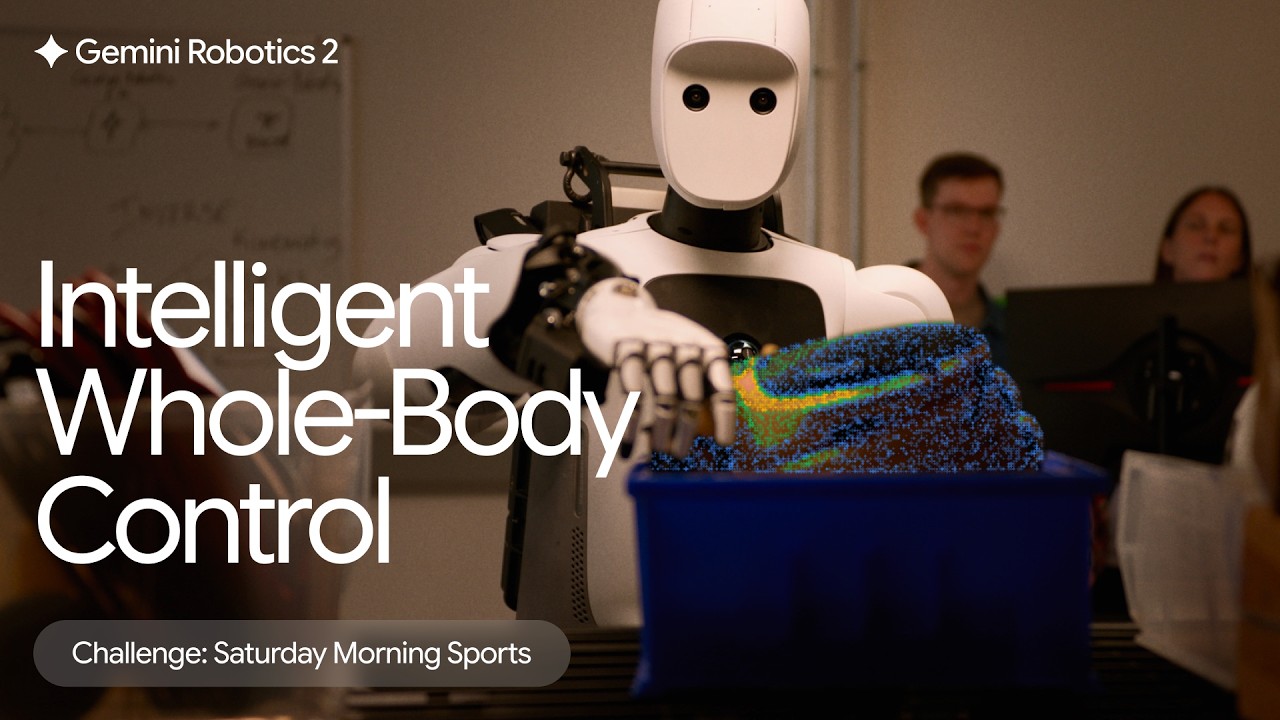 📺 Intelligent whole-body control with Gemini Robotics 2
Gemini Robotics: Whole-Body Control and Embodied Reasoning in Action
▼
📺 Intelligent whole-body control with Gemini Robotics 2
Gemini Robotics: Whole-Body Control and Embodied Reasoning in Action
▼
This video demonstrates Google's Gemini Robotics embodied reasoning model, which enables a humanoid robot to understand natural language instructions, perceive its environment, and coordinate its entire body to complete complex tasks. It highlights the challenges of whole-body control, real-time balance, and reactive decision-making in cluttered real-world settings.
■ Core Technology
- Embodied reasoning model understands visual scenes and natural language
- VOA vision-language-action model translates instructions into robot actions
■ Demonstrated Capabilities
- Whole-body coordination and balance during object manipulation
- Navigation in cluttered environments and failure recovery
■ Development Vision
- Toward generalist robots for diverse real-world tasks
- AI as the missing piece in robotics
Viewers interested in robotics, AI, and embodied intelligence will gain insight into how modern AI models are applied to real-world robot control and the current capabilities and limitations of humanoid robots.
 📺 Multi-robot collaboration with Gemini Robotics 2
Gemini Robotics 2: Multi-Robot Collaboration for Complex Tasks
▼
📺 Multi-robot collaboration with Gemini Robotics 2
Gemini Robotics 2: Multi-Robot Collaboration for Complex Tasks
▼
Gemini Robotics 2 adds a feature that enables multiple robots to collaborate on the same task simultaneously. This release demonstrates how a humanoid robot and a dual-arm robot work together to tidy a garage and organize tools.
■ Multi-robot coordination
- High-level reasoning breaks down tasks and determines when each robot should act
- Apollo humanoid hands off control to the dual-arm robot for precise steps
■ Precision and control
- Maintains precise motion for gripper and bi-arm tasks
- Each robot runs the same AI stack and orchestrates via reasoning
■ Communication and expansion
- Robots communicate with each other and decide when to assist
- Collaboration expands the range of tasks robots can perform
Robotics enthusiasts and developers will learn how high-level reasoning, precision control, and inter-robot communication are combined to expand the range of tasks robots can perform in real-world settings.
 📺 Advanced dexterity with Gemini Robotics 2
Advancing Robot Dexterity with Gemini Robotics
▼
📺 Advanced dexterity with Gemini Robotics 2
Advancing Robot Dexterity with Gemini Robotics
▼
We present Gemini Robotics, a research effort focused on giving robots the dexterity required for real-world tasks. Through a series of hands-on challenges, we demonstrate how AI models control 22 separate joints to perform precise manipulations. The video highlights both the progress and the remaining difficulties in robotic dexterity.
■ Dexterity Tasks
- Packing lunch: placing grapes into a ziplock bag and closing it
- Unscrewing a bulb: precise fingertip contact and coordinated twist, push, and pull motions
■ Advancing Robotic Manipulation
- Improving parallel grippers with dexterity, precision, and 3D space understanding
- Reorienting objects and tools in space for precise placement
- Tying a knot in a trash bag using multi-fingered hands
This video is intended for those interested in robotics, AI, and dexterous manipulation. Viewers will gain insight into the challenges and progress in enabling robots to handle complex real-world objects, with potential applications in hazardous waste handling.
 📺 Gemini Robotics 2 brings whole body intelligence to robots
Gemini Robotics 2: A Generalist Model for Humanoid Robots
▼
📺 Gemini Robotics 2 brings whole body intelligence to robots
Gemini Robotics 2: A Generalist Model for Humanoid Robots
▼
Gemini Robotics 2 is a generalist robotics model designed to enable a single robot to perform many different tasks. This release focuses on three main capabilities: whole-body control, dexterous manipulation, and multi-robot collaboration.
■ Core Approach
- Generalist model versus specialized robots
- AI as a way to handle the complexity of human environments
■ Key Features
- Whole-body coordinated movement
- Dexterous hand manipulation beyond pick-and-place
- Multi-robot collaboration through individual reasoning
■ Development Insights
- Trash bag task initially considered impossible
- Emphasis on intelligence and adaptability to changing scenes
This video is suited for those interested in AI robotics and the latest advances in generalist robot models. Viewers will gain an understanding of the technical focus areas and the challenges involved in building humanoid robots.
 📺 Reconstructing Pelé’s lost goal
Recreating Pelé's Unfilmed 1959 Goal with AI and Historical Research
▼
📺 Reconstructing Pelé’s lost goal
Recreating Pelé's Unfilmed 1959 Goal with AI and Historical Research
▼
This video documents the process of recreating a goal scored by Pelé in 1959, a play that was never captured on film. It explores how historical research, artificial intelligence, and live-action performance were combined to bring this unrecorded moment back to life.
■ Historical Background
- The August 2, 1959 match between Santos and Juventus at Rua Javari
- Eyewitness accounts and photographs as the only source material
■ AI and Production Process
- Using Gemini Omni to generate period-accurate imagery
- Motion transfer technology and local actors for the recreation
■ Purpose and Legacy
- Preserving Pelé's legacy for new generations
- Demonstrating AI's role in historical reconstruction
This video is intended for football enthusiasts, technology professionals, and anyone interested in the intersection of sports history and artificial intelligence. Viewers will learn how unrecorded historical moments can be reconstructed with modern tools.
 📺 Understanding the inner thoughts of AI
Inside the Black Box: How Interpretability Research Decodes AI's Inner Workings
▼
📺 Understanding the inner thoughts of AI
Inside the Black Box: How Interpretability Research Decodes AI's Inner Workings
▼
In this episode, Professor Hannah Fry speaks with Neil Nanda, who leads the language model interpretability team at Google DeepMind, about the field of interpretability and its role in understanding and safely developing AI systems. The conversation covers the fundamental challenge of opening up the 'black box' of neural networks, the practical techniques used to peer inside them, and the implications for AI safety and alignment.
■ The Need for Interpretability
- Why neural networks are 'grown' rather than designed, and the analogy to evolution
- The safety and scientific motivations for understanding AI systems
■ Techniques for Peering Inside
- Chain-of-thought reasoning as a 'scratch pad' and its current usefulness and limitations
- Probing: training simple classifiers to find directions for concepts like happiness or truthfulness
- Sparse autoencoders: automatically discovering concepts the model uses, with examples like hallucination detection
■ Interpretability for Safety and Alignment
- Using probes and sparse autoencoders to detect misuse, including cybercrime attempts
- The challenge of evaluation awareness: models that realize they are being tested and adjust their behavior
- Auditing hidden objectives with techniques like prefill attacks and sparse autoencoders
■ The Future of Interpretability
- The shift toward pragmatic interpretability: using simple tools when they work and reserving complex methods for harder problems
- The role of interpretability in building monitors, auditing alignment, and understanding the 'psychology' of language models
This episode is for anyone interested in how AI works under the hood, the current state of interpretability research, and the practical steps being taken to make advanced AI systems safer and more trustworthy.
📄 このページの紹介文は AI が独自に生成したものであり、著作権をはじめとする他者の権利(商標権・名誉権・プライバシー等)を侵害しないよう配慮しています。動画の著作権は各作成者に帰属します。